How setting money aside is making it easier for me to spend in retirement.
My first full calendar year after retiring is quickly coming to a close, and I’m still struggling to let go of the working-years money habits that got me here. I’ve written about the switch from saving to spending, but aside from the psychological pivot, there are a lot of practical considerations to contend with.
At first the mindset switch sounds simple – stop saving, just decide what you want to spend, and that’s your income.
But the myriad of retirement rules that govern how we report income make that strategy seem grossly oversimplified. Whether you’re an early retiree like me dealing with income limits that could cost me big in lost ACA credits, or a near- or over-65 retiree dealing with IRMAA thresholds right out of the gate, there are good reasons to be deliberate in how (and how much) you withdraw.
My ACA income threshold is a constraint I knew I’d have for the first few years. And honestly, it is turning out to be a helpful guardrail against wildly overspending in newly-retired exuberance. I’m starting to incorporate that guardrail into my future plans – ACA threshold will give way to IRMAA threshold, and while that penalty is not as drastic (and the threshold much higher), it lets me fall back on familiar habits when I plan for large expenditures (read, big trip!).
Once we start withdrawing from the nest egg, most of us have several possible sources of cash flow. And how we choose among them matters.
Many financial experts advise creating a regular stream of cash flow to cover our basic monthly expenses, and I have adopted this strategy, largely because it is familiar from my working years – salary covers monthly expenses, and bonus covers the big planned expenditures. It just feels right to me. I start with a base, and from that I have a pretty good idea where my taxable income will start for the year.
It makes sense for that base to start with the income I don’t have control over - Social Security, my pension annuity, and the dividends from my taxable brokerage account (they’re being taxed anyway, they may as well be part of my cash flow). Scheduled Roth or Traditional IRA withdrawals make up the balance to cover my monthly expenses with a small buffer. Now I know how close I am to an income threshold that could trigger penalties, and where I stand when I start to budget for large expenses (eg. a big trip or a home renovation). From there I can see how to best fund the year’s big spending.
I’m looking for a balance – not increasing my income into penalty territory while also not depleting my liquid asset reserves, which I consider my “relief valve” for the unexpected:
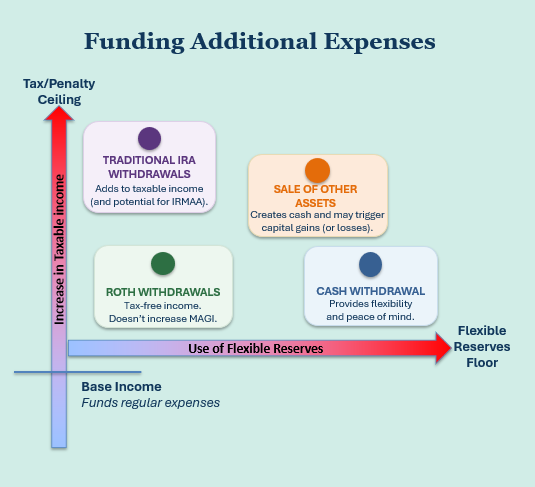
But what happens when the expense is too big to fit comfortably between those two boundaries? Full disclosure, I’m already planning my 65th birthday celebration, and I want it to be big. But a bigger expenditure might be replacing an old car or putting a new roof on the house. Mine just happens to be more fun.
One strategy for a big expense is to spread the income needed to fund it over multiple years — often called income smoothing. Say I’m planning a $30,000 expense, but I don’t have a $30,000 gap between my “increase taxable income” and “use flexible reserves” boundaries. I could instead set aside $10,000 in years when I have room. I could deliberately recognize some additional taxable income and save the resulting cash until I'm ready to spend it.
Congratulations, Andrea, you’ve just reinvented your old savings account. The very thing you weren’t supposed to need anymore.
After I got over the irony, I was actually very comfortable with the concept. I really don’t like depleting those cash (and other asset) reserves that are the relief valve for the unexpected. And something about saving up for these big expenditures makes me feel like I’ve earned them. Of course I’ve already earned the money. The account isn’t creating that. But it’s almost as if it’s giving permission to spend it.
With all the uncertainty that hovers over retirement, having that permission in the context of deliberate planning (and yes, savings) is reassuring.
I know there’s a cost to keeping more money in cash. That money could potentially earn more if it stayed invested. But I think that’s the price of flexibility — both in managing taxable income and in being comfortable spending the money. It’s a tradeoff, for sure, but a deliberate one.
And there’s a different opportunity cost to consider – missed opportunities to use the money in meaningful ways. When all my cash is in one bucket that I’ve mentally designated for emergencies, I won’t spend it. But setting a little aside specifically for spending frees me from that mindset.
I’ve been referring to one savings account, but I think there’s also value in earmarking a bit of funds for future possibilities. If I’m underspending on my regular expenses, rather than shrinking my paycheck I could park the excess funds for later, less-planned use. One day I may want to take my grandkids to Disney World, or spring for a first-class airline ticket, or pay for a friend to join me. I like the concept of keeping a little “dry powder” for life.
We put so much pressure on ourselves to make the money last. But there’s no reason managing our finances can’t be hopeful.